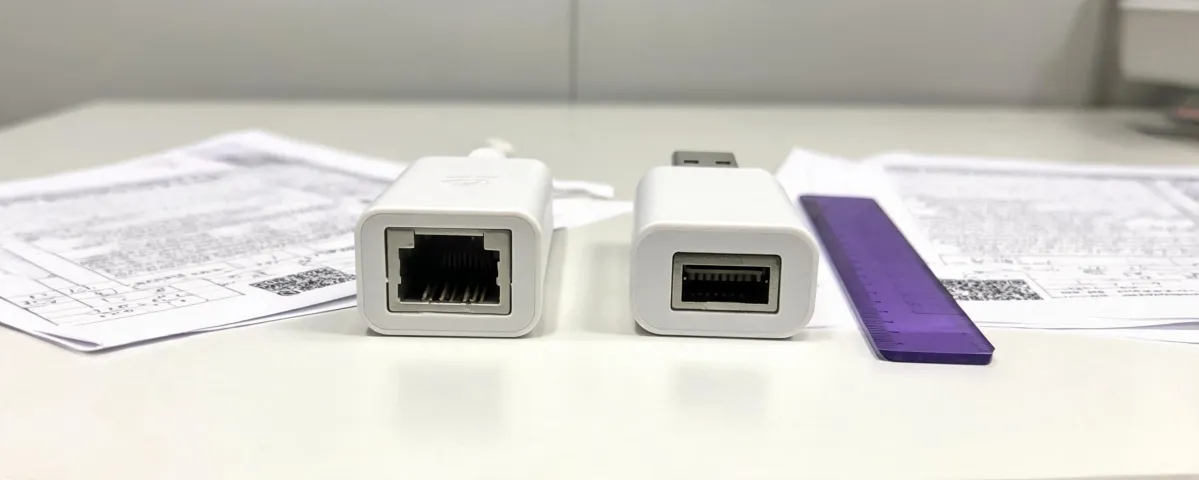
Choices that should stay marked open
Plug generation
USB 2.0 bus signaling at 480 Mb/s can still carry a 1000BASE-T conversation if the host and the PHY agree, but the bus current budget is tighter than on a USB 3.x port. Write the plug you have, not the plug a photo shows. A USB-C port that supplies charge and blocks data cannot be assumed to pass packets; that limit is a host fact the factory cannot see.
PHY versus cable plant
1000BASE-T uses four pairs. A damaged cord that leaves two pairs will not become gigabit because the adapter label says gigabit. Ask whether the quote includes the cord. Impedance near 100 ohm, insertion loss, and return loss are properties of that cord and the channel, measured under a stated method. They are not a slogan on the dongle blister. If the lab will test the channel, name the method. If nobody will test it, say so.
Driver and chipset
Record the chipset string the datasheet prints and the operating system builds in the image. A substitute with a different chipset can be acceptable when those builds load. It is a deviation when they do not. “Compatible” without a chipset is an incomplete cell, not a middle price.
Mechanical and environment
Body width in millimetres decides whether the next USB port stays usable. Captive length in centimetres decides whether a dock reaches the jack. Connector mating cycle matters on a bench and rarely on a dock that is plugged once. Ingress protection matters if the adapter is not in a dry room. Ask for the figure the drawing states.
Checks before an alternative is accepted
- Manufacturer and model on the quotation match the datasheet filename and the shell mark.
- PHY speed is a number with a unit, not an icon. 100 Mb/s, 1000 Mb/s, and 2.5 Gb/s are different offers.
- Bus current at 5 V is copied from that model’s table. A 500 mA USB 2.0 figure must not be swapped with a USB 3.x figure from a sibling SKU.
- Driver builds name the operating systems in the buyer’s image, including major version.
- If the factory cites FCC equipment authorization, the grant or supplier declaration names this model. A logo without an identifier is not the check.
- Included cord length, external supply, and pack count are either in the unit price or on separate lines. Freight names the US destination.
- Condition is new or a stated surplus grade. Unknown condition stops the comparison.
- The buyer’s engineer, not this desk, runs the host link test that will be used for acceptance.
Arguments that change the evidence pack
A USB ethernet adapter quote should name the bus, the link speed it can hold, and whether any utility is included. If a utility exposes checksum offload or a VLAN tag, treat that utility as optional software and ask whether the quote includes it. Forwarding rate and switching capacity describe a switch chassis, so leave them out of the adapter cell.
OEM-coded versus compatible, in this family, means a named model the image already carries versus another shell with a stated chipset. The named model may track a vendor’s support note more directly. The other shell may be sourceable when the chipset and the PHY are verified on the exact host. Both need the same eight checks above. A lower printed number with a missing driver row is an incomplete file.
New versus refurbished changes provenance. New may have a clearer warranty start. Refurbished may be the available way to keep a legacy USB-A image alive. Ask for cosmetic grade, firmware or driver date, and what the warranty actually covers. The bus-current line of a USB dongle is not a radio or optical specification. Ask for bus power, link speed, and the driver date instead.
Procurement scenario: accepting a substitute plug
Background: the original note asked for USB-A because the cart PCs have those ports. A factory offers a USB-C body plus a short A-to-C adapter, quantity 60, destination Arizona. Process: the buyer lists the extra joint as a deviation, asks for mating-cycle notes on both connectors, and requires the chipset driver on the cart image. The price of usb to ethernet adapter is then two lines: the C body and the passive adapter. Result: the substitute can be compared with a native USB-A dongle on the same piece count, the same destination, and the same driver row. If the passive adapter’s current rating is missing, that offer waits. This desk does not declare the pair interoperable.
The USB-C scope and the catalog rows are the neighboring worksheets. IEEE 802.3 remains a family reference for the PHY name, not a test report for the pair you will buy.